Section4.2Convergence of the Trigonometric Fourier Series
We now investigate the issue of convergence of the trigonometric Fourier series. To simplify the set up, we will take \(l=\pi\) from now on; the general case can be reduced to this case by a simple change of variables \(x\mapsto \pi x/l\text{.}\)
If we only take \(\lambda=N\) as integers, then this follows from the Bessel’s inequality. The same argument also shows that \(\int_{-\pi}^{\pi} h(t)\cos(N t)\, dt\to 0\) as \(N\to \infty\text{.}\) These properties are sufficient for applications to \(\int_{-\pi}^{\pi}
h(x; t) \sin (N+\frac 12)t\; dt\text{,}\) as \(\sin (N+\frac 12)t=\cos\frac t2 \sin(Nt)+\sin\frac t2 \cos(Nt)\text{.}\)
as \(\lambda \to \infty\text{.}\) For the given \(h\in \cR[-\pi, \pi]\text{,}\) take any \(\epsilon \gt 0\text{,}\) we first find some \(\hat h \in C^{1}[-\pi, \pi]\) such that \(\int_{-\pi}^{\pi} |h(t)-\hat h(t)|\, dt \lt \epsilon\text{.}\) Then
and \(\vert \int_{-\pi}^{\pi} \hat h(t)\sin(\lambda t)\, dt \vert \lt \epsilon\) for all sufficiently large \(\lambda\text{,}\) which concludes our proof.
Theorem4.2.2.A Convergence Criterion for the Trigonometric Fourier series.
Suppose that \(g\) is a \(2\pi\) periodic function on \(\bbR\) and \(x\in (-\pi, \pi)\) is such that there exist \(\delta> 0\) and \(M < \infty\) such that
\begin{equation}
|g(x+t)-g(x)|\le M |t| \text{ for all } t\in (-\delta, \delta).\tag{4.2.1}
\end{equation}
Then \(S_N[g]( x)-g(x)\to 0\) as \(N\to\infty\text{.}\)
Under our assumption, \(h(x; t)=\frac{g(x-t) -g(x)}{\sin \frac t2}\) is Riemann integrable on \((-\pi, \pi)\text{,}\) so we can apply the Riemann-Lebesgue Lemma 4.2.1 to draw our conclusion.
Condition (4.2.1) implies that \(g\) is continuous at \(x\text{.}\) Note that if \(g'(x)\) exists, then (4.2.1) is satisfied at \(x\text{.}\) In fact, (4.2.1) is satisfied at \(x\) if both the left derivative \(g'(x-)\) and the right derivative \(g'(x+)\) exist.
Note that whether or not \(h(x; t)\) is integrable so as to apply Lemma 4.2.1 depends only on the the local behavior of \(g(t)\) near \(x\text{,}\) so whether or not \(S_N[g]( x)\) converges depends only on the local behavior of \(g(t)\) near \(x\text{.}\) This is known as the Riemann’s localization theorem.
As a consequence of the above theorem, if \(g\in C[-\pi, \pi]\) and has continuous derivative on \(C[-\pi, \pi]\text{,}\) we can redefine \(g(-\pi)\) to be \(g(\pi)\) and extend this function to be a \(2\pi\) periodic function on \(\bbR\text{.}\) Then the resulting function satisfies the assumption of the above theorem at any \(x\) such that \(-\pi \lt x \lt \pi\text{,}\) so \(S_N[g]( x)\to g(x)\) as \(N\to \infty\text{.}\) At \(x=\pi\text{,}\) the left limit of the extended function is \(g(\pi)\) and the right limit of the extended function is \(g(-\pi)\text{.}\) Thus \(S_N[g]( \pi)\to \frac{g(\pi)+g(-\pi)}{2}\) as \(N\to \infty\text{.}\) Since the Fourier series expansion here is \(2\pi\) periodic, the proper interpretation of the expansion is that the series equals the \(2\pi\) periodic extension of the given function on \((-\pi, \pi]\) in the above sense.
In applying Fourier expansions, it is important to have a keen awareness of the system of orthogoal functions we are working with. For example, if we are working with the set of orthogonal functions \(\{ \sin (nx): n\in \mathbb N\}\) on \([0, \pi]\text{,}\) then the Fourier series expansion of a function \(f\in \cR[0, \pi]\) with respect to this set of orthogonal functions is \(\sum_{n=1}^{\infty} b_{n} \sin (nx)\text{,}\) where \(b_{n}=\frac{2}{\pi} \int_{0}^{\pi} f(x) \sin (nx)\, dx\text{.}\) The proper interpretation of this expansion is that the series equals the odd extension of the given function on \((-\pi, \pi)\) in the above sense. In particular, if \(f\in C[0, \pi]\) and \(f(0)\ne 0\) or \(f(\pi)\ne 0\text{,}\) then the odd extension of \(f\) is not continuous at \(0\) or at \(\pi\text{,}\) so the Fourier series expansion of \(f\) with respect to the set of orthogonal functions \(\{ \sin (nx): n\in \mathbb N\}\) at \(0\) or at \(\pi\) does not converge to \(f(0)\) or to \(f(\pi)\text{,}\) but converges to \(0\) instead. A similar phenomenon occurs if we are working with the set of orthogonal functions \(\{ \cos (nx): n\in \mathbb N\cup \{0\}\}\) on \([0, \pi]\text{,}\) then the Fourier series expansion of a function \(f\in \cR[0, \pi]\) with respect to this set of orthogonal functions is \(\frac{a_0}{2}+\sum_{n=1}^{\infty} a_{n} \cos (nx)\text{,}\) where \(a_{n}=\frac{2}{\pi} \int_{0}^{\pi} f(x) \cos (nx)\, dx\text{.}\) The proper interpretation of this expansion is that the series equals the even extension of the given function on \((-\pi, \pi)\) in the above sense.
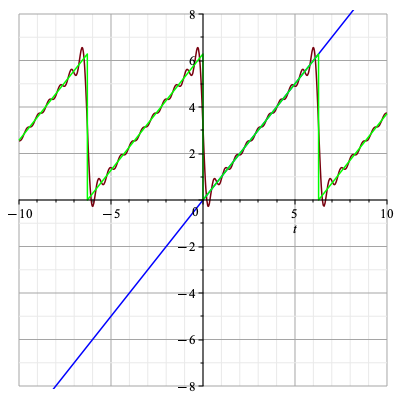
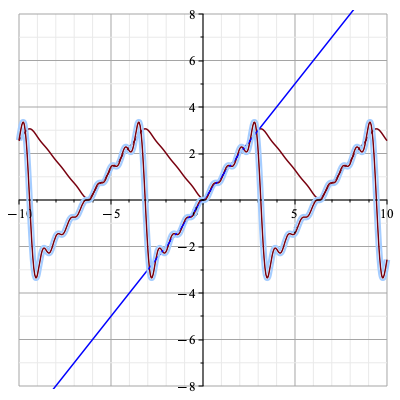
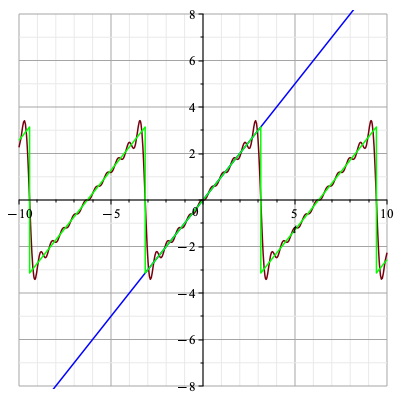
Often, a function \(g\) is given by some analytic expression, but that expression outside of the relevant interval has no direct bearing on the Fourier series expansion of \(g\) with respect to a given set of orthogonal functions. The following figures illustrate the above phenomenon of different extensions of a given function on \([0, \pi]\) or on \([-\pi, \pi]\) and the resulting different Fourier series expansions with respect to the sets of orthogonal functions.
For any \(x\in (-\pi, \pi)\text{,}\) there exist continuous functions \(f\) such that \(S_N[f](x)\) does not converge, so continuity of \(f\) at \(x\) alone may not guarantee that \(S_N[f]( x)\) converges as \(N\to\infty\text{.}\)
Suppose that the Riemann integrable function \(f\) on \((-\pi, \pi)\) is continuous at \(x\in (-\pi, \pi)\text{,}\) then \(\sigma_{N}[f](x)\to f(x)\) as \(N\to \infty\text{.}\) If \(f\) is continuous on \([-\pi, \pi]\) and is \(2\pi\) periodic, then \(\sigma_{N}[f](x)\to f(x)\) uniformly over \([-\pi, \pi]\) as \(N\to \infty\text{.}\) Suppose that \(f(t)\) has both a right limit \(f(x+)\) and a left limit \(f(x-)\) at \(x\text{,}\) then \(\sigma_{N}[f](x)\to \frac{f(x+)+f(x-)}{2}\) as \(N\to \infty\text{.}\)
and for any \(\epsilon > 0\text{,}\) we first choose \(0 < \delta <\pi\) such that \(|f(x-t) -f(x)| < \epsilon\) for all \(t\) with \(|t|\le \delta\text{,}\) then use this \(\delta\) in the above, which will make the first integral above \(< \epsilon\) using (b) above. Finally, for sufficiently large \(N\text{,}\) the second integral above will also be less than \(\epsilon\) using (c) above. This proves the first assertion. When \(f\) is continuous on \([-\pi, \pi]\) and is \(2\pi\) periodic, then \(\delta\) above can be chosen independent of \(x\in [-\pi, \pi]\text{,}\) which shows that the convergence is uniform over \([-\pi, \pi]\text{.}\)
If \(f\) has both left and right limits at \(x\text{,}\) one could use the evenness of \(K_{N}(t)\) or \(D_{N}(t)\) to rewrite the integral \(\int_{-\pi}^{\pi}\) as two separate integrals. For example,
Fejér’s theorem implies that the span of \(\{ e^{i nx}\}\) (equivalently \(\{\cos(nx), \sin(nx)\}\)) is dense in both \(C[-\pi, \pi]\) and \(\cR[-\pi ,\pi]\) in the mean square sense, for, given any \(g\in \cR[-\pi ,\pi]\) and \(\epsilon \gt 0\text{,}\) first find a \(2\pi\) periodic and continuous function \(f\) such that \(\Vert f-g\Vert :=\left(\int_{-\pi}^{\pi}|f(t)-g(t)|^{2}\, dt\right)^{1/2}\lt \epsilon\text{.}\) Then find \(N\) such that \(\Vert f- \sigma_{N}(f)\Vert \lt \epsilon\) by the above theorem. Finally triangle inequality implies that \(\Vert g- \sigma_{N}(f)\Vert \lt 2\epsilon\text{.}\)
Theorem4.2.7.Mean Square Convergence and Parseval Equality.
For any \(g\in \cR[-\pi ,\pi]\text{,}\)\(\Vert S_{N}(g)-g\Vert\to 0\) as \(N\to \infty\text{.}\) As a consequence, the following Parseval equality holds:
Since the span of \(\{ e^{i nx}\}_{n=-N'}^{N'}\) is a subspace of \(\{ e^{i nx}\}_{n=-N}^{N}\) when \(N' \le N\text{,}\) the Best Approximation Theorem implies that
For any \(\epsilon \gt 0\text{,}\) Fejér’s theorem gives some trigonometric polynomial \(p\) of degree \(N'\) such that \(\Vert g- p\Vert \lt \epsilon\text{.}\) Then the Best Approximation Theorem implies that \(\Vert S_{N'}(g)-g\Vert \lt \epsilon\text{.}\) Then for all \(N\ge N'\text{,}\) we have \(\Vert S_{N}(g)-g\Vert\le \epsilon\text{.}\) The Parseval equality follows from (4.1.3).
Suppose not. Let \(g\in L^{2}[-\pi, \pi]\) be a non-zero function in \(L^{2}[-\pi, \pi]\) orthogonal to each \(e^{i nx}\text{.}\) We may assume that \(\Vert g \Vert =1\text{.}\) Then for any trigonometric polynomial \(p\) of the form \(\sum_{n=-N}^{N}c_{n }e^{i nx}\text{,}\) the orthogonality property implies that
\begin{equation*}
\Vert g - p\Vert^{2}=\Vert g \Vert^{2}+ \Vert p\Vert^{2}\ge 1.
\end{equation*}
But we can find a continuous \(2\pi\) periodic function \(f\) such that \(\Vert g-f\Vert \lt \frac 14\text{,}\) and a trigonometric polynomial \(p\) of the form \(\sum_{n=-N}^{N}c_{n }e^{i nx}\) such that \(\Vert p-f\Vert \lt \frac 14\text{.}\) Then the triangle inequality implies that