Section 6.7 A Brief Discussion on the Integration of Functions on a Surface

Examples of surfaces are easy to visualize, but the definition for a general surface is not easy, as there is no easy way to use a single parametric representation defined on a simple domain in the Euclidean space to represent a general surface. On the other hand, a local patch of a surface can always be represented by a single parametric map defined on a simple domain such as square or disc in the Euclidean space. Our focus will be on the study of such a local patch. But different parametric representations may represent the same surface patch, so we need to understand how the analytic and geometric properties of such a patch depend on the parametric representations.
The definition for the area of a surface and integral on a surface is even harder, as a general surface has no simple surface cells that have a natural and simple formula for their areas as rectangles do in a plane, so there is no easy way to define an integral on a surface directly using partitions of the surface.
We will use a parametric representation to define the area of a surface patch and verify that it is independent of the parametric representation used.
We will briefly discuss the integration of functions on a surface patch reducing it to the integration on a parametric cell.

Subsection 6.7.1 Definition of an \(m\)-dimensional Differentiable Surface in \(\bbR^{n}\)

It seems natural to define a two dimensional surface as the graph in some \(\bbR^{n}\) (\(n>2\)) of a continuously differentiable function defined over a two dimensional region in the flat Euclidean plane \({\mathbb R^{2}}\subset \bbR^{n}\text{.}\) But a surface as simple as the round sphere can’t be represented as the graph of a single differentiable function. This graph feature becomes possible if one only requires this property locally near each point and allows for possibly different coordinate planes depending on the point over which to view the surface patch near the point as a graph.

Definition 6.7.1. Definition of an \(m\)-dimensional Differentiable Surface in \(\bbR^{n}\).

A subset \(S\) of \(\bbR^{n}\) is called an \(m\)-dimensional differentiable surface (\(m \lt n\)), also called an \(m\)-dimensional differentiable manifold, if for each point \(p\in S\text{,}\) there exists a neighborhood \(B(p, r)\) (\(r >0\)) of \(p\) in \(\bbR^{n}\) and a differentiable function \(G\) defined in a neighborhood \(W\) of the coordinate projection \(p'\) of \(p\) to some \(m\)-dimensional coordinate subspace \(\bbR^{m}\text{,}\) where, for simplicity of notation, we take \(p=(p_{1},\cdots, p_{n})\text{,}\) \(p'=(p_{1},\cdots, p_{m}, 0,\cdots, 0)\text{,}\) and \(W\) is open considered as a subset of \(\bbR^{m}\text{,}\) such that
\begin{equation*} S\cap B(p, r)=\{(\bx, G(\bx)):\bx\in W \subset \bbR^{m}\}\text{.} \end{equation*}
The conceptual difficulty of the above definition is that the function \(G(\bx)\) and its domain \(W\) are not necessarily known explicitly or easily found and are allowed to vary with the point chosen, although they are often guaranteed by TheoremΒ 5.5.8.

Proof.

But (6.7.1) may not be easy to verify in concrete situations. It seems easier to consider the image of a continuously differentiable map defined over an \(m\)-dimensional region in the flat Euclidean plane \(\bbR^{m}\) as a prototype over which to define a general \(m\)-dimensional surface. But in order for such a parametric representation to possess the usual properties of an \(m\)-dimensional surface, we need to assume that at each point the Jacobian matrix has rank \(m\text{;}\) this will guarantee that the image of the map does not degenerate into a lower dimensional object and indeed looks like an \(m\)-dimensional surface. Below is a more precise statement.

Proof.

This is done as follows by applying the Inverse Function Theorem. For simplicity of notation, we will write out the case of \(m=2\text{.}\) Here one may assume that \(\frac{\partial (f_{1}, f_{2})}{\partial (u, v)} \ne 0\) at \((u_{0}, v_{0})\text{,}\) then one applies the Inverse Function Theorem to \((u, v)\mapsto (x_{1}, x_{2})=(f_{1}(u,v), f_{2}(u,v))\) to show that it has a continuously differentiable inverse \(H\) defined on some open set \(W\) of \(\mathbb R^{2}\) containing \((f_{1}(u_{0},v_{0}), f_{2}(u_{0},v_{0}))\) and \(H(W)=V\subset U\) is an open neighborhood of \((u_{0}, v_{0})\text{.}\) Then
\begin{equation*} F\circ H(x_{1}, x_{2})= (x_{1}, x_{2}, f_{3}\circ H(x_{1}, x_{2}),\ldots, f_{n}\circ H(x_{1}, x_{2})) \end{equation*}
defines the desired graph over \(W\text{.}\)
It is often not necessary to find this graph representation explicitly, but work directly with the parametric representation \(\bu \in U\mapsto F(\bu)\text{.}\) For a geometric surface, one either imposes that \(F\) be injective and has a continuous inverse on \(F(U)\text{,}\) or restricts to a small enough neighborhood so that this property holds. We call this a surface patch when \(U\subset \bbR^{m}\) with \(m=2\) and for a general \(m\) a manifold patch.

Subsection 6.7.2 Volume of the Image of a Unit Hypercube under a Linear Map

Any notion of area of a surface or volume of a higher dimensional manifold must obey the universal property:
\begin{equation} v(E\cup F)=v(E)+v(F)-v(E\cap F) \text{ when $v(E), v(F)$ are well defined.}\tag{6.7.2} \end{equation}
In addition, when two surfaces are obtained from each other by an isometry such as translation, rotation, reflection, or bending, they should have equal area. For example, a round cylinder of diameter \(2\) and height \(1\text{,}\) when cut open along a generator on the side, unfolds into a rectangle of sides \(1\) and \(2\pi\text{,}\) respectively, thus should have its area equal to \(2\pi\text{.}\)
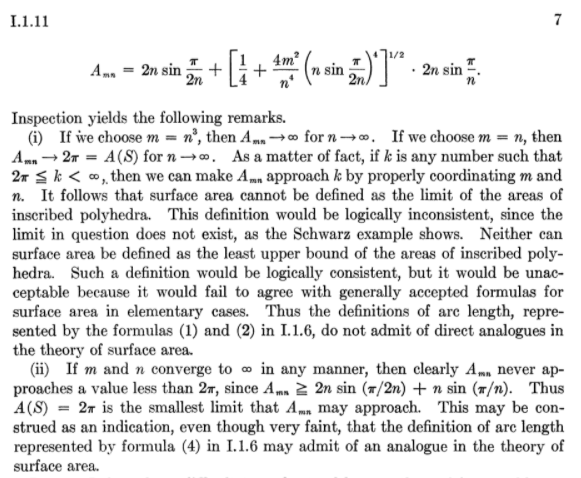
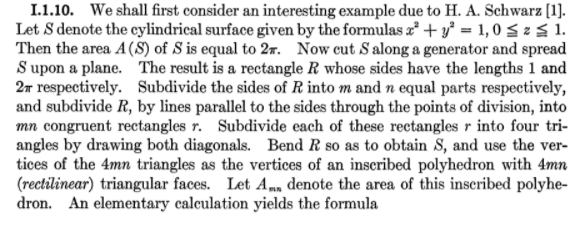
A naive generalization of the idea of defining the area of a surface as the least upper bound of the area of the inscribed triangulated surfaces turns out not valid. H. A. Schwarz found that even in the case of the round cylinder, the least upper bound of area of the inscribed triangulated surfaces is \(\infty\text{.}\) This is explained in Rad’s Length and Area, AMS Colloquium Lectures, 1948.
Figure 6.7.4. Radó’s description of H. A. Schwarz’s discovery that the least upper bound of area of the inscribed triangulated surfaces of a section of the round cylinder is infinity.
Let’s next work out how to compute the area of a patch of a surface lying on an \(m\)-dimensional plane in \(\bbR^{n} (n\ge m)\) as given by a parametric representation via a linear map. Let \(A\) be an \(n\times m\) matrix with rank \(m\) and \(m\le n\text{.}\) Consider
\begin{equation*} F: x \in \mathbb R^m \mapsto Ax \in \mathbb R^n. \end{equation*}
\(F(\bbR^{m})\) is an \(m-\)dimensional subspace of \(\mathbb R^n\text{.}\) Let \(U\) be the standard cube in \(\mathbb R^m\text{,}\) then \(F(U)\) is a parallelepiped in \(F(\mathbb R^m)\text{,}\) with \(\text{ col}_j(A)\text{,}\) \(j=1,\ldots, m\) as edges. In the case of \(m=2\) and \(n=3\text{,}\) \(F(U)\) is a parallelogram with \(\text{ col}_1(A), \text{ col}_2(A)\) as edges and we know that its area can be computed as \(|\text{ col}_1(A)\times \text{ col}_2(A)|\text{.}\)
We now develop a formula for higher dimensional settings in the absence of cross product.

Proof.

Choose an orthonormal basis \(\tau_1,\ldots, \tau_m\) of \(F(\mathbb R^m)\text{,}\) and express each \(\text{ col}_j(A)\) in terms of this basis:
\begin{equation*} \text{ col}_j(A)=\sum_{i=1}^m B_{ij}\tau_i, \end{equation*}
and let \(B\) be the \(m\times m\) matrix \((B_{ij})\text{.}\) Then
\begin{equation*} F(\bx) =\sum_{i=1}^m \left( \sum_{j=1}^mB_{ij}x_{j}\right) \tau_i =\left[\tau_1 \cdots \tau_m\right] B\bx \end{equation*}
so in terms of the basis \(\tau_1,\ldots, \tau_m\text{,}\) \(F(\bx)\) can be treated as given by \(B\bx\text{,}\) and \(F(U)\) can be thought of as obtained from the unit cube in \(F(\mathbb R^m)\) by applying the linear transformation through multiplication by \(B\text{,}\) and by our earlier discussion
\begin{equation*} \text{ Volume} (F(U)) = |\det B | \text{ Volume}(U)=|\det B |. \end{equation*}
On the other hand, the relations between \(A\) and \(B\) can be written as
\begin{equation*} A= \left[\tau_1 \cdots \tau_m\right] B, \end{equation*}
so
\begin{equation*} A^{\rm T}A=B^{\rm T} \left[\tau_1 \cdots \tau_m\right]^{\rm T} \left[\tau_1 \cdots \tau_m \right] B = B^{\rm T}B, \end{equation*}
using
\begin{equation*} \left[\tau_1 \cdots \tau_m\right]^{\rm T} \left[\tau_1 \cdots \tau_m \right] = I_m. \end{equation*}
Now it follows that
\begin{equation*} |\det B |= \sqrt {\det B \det B^{\rm T}} = \sqrt {\det (B^{\rm T}B)}= \sqrt {\det (A^{\rm T}A)} \end{equation*}
(\(B\) is square while \(A\) may not be square, so we can not have \(\det (A^{\rm T}A)=\det (A^{\rm T})\det (A)\)), and we arrive at (6.7.3).

Remark 6.7.6.

Note that the \((i, j)\) entry \(g_{ij}\) of \(A^{\rm T}A\text{,}\) is \(\text{ col}_i (A) \cdot \text{ col}_j (A)= Ae_i \cdot Ae_j\text{.}\) This is one of the geometric origins for the Riemannian metric tensor and the appearance of the area (volume) form \(\sqrt {\det (g_{ij})}\, d\bu\text{.}\)
After we develop exterior algebra, we will find that
\begin{equation*} \text{ col}_1(A)\wedge \text{ col}_2(A)\wedge\cdots\wedge \text{ col}_m(A)= \left( \det B\right)\, \tau_{1}\wedge \tau_{2}\wedge\cdots\wedge \tau_{m}, \end{equation*}
so \(\det B\) encodes the geometric relation between \(\text{ col}_1(A)\wedge \text{ col}_2(A)\wedge\cdots\wedge \text{ col}_m(A)\) and \(\tau_{1} \, \wedge \tau_{2}\wedge\cdots\wedge \tau_{m}\) formed from two bases of \(F(\bbR^{m})\text{.}\)

Example 6.7.7.

The area of the parallelogram in \(\bbR^{n}\) with \(\ba =(a_{1},\cdots, a_{n})\) and \(\bb =(b_{1},\cdots, b_{n})\) as its adjacent edges is given by
\begin{equation*} \sqrt{\det \begin{bmatrix} \ba\cdot\ba \amp \ba \cdot \bb \\ \ba\cdot \bb \amp \bb \cdot \bb \end{bmatrix}}. \end{equation*}

Exercises Exercises

1.
Find the area of the subset of the solution set of
\begin{equation*} \begin{cases} x_{1} \hphantom{x_{2}}-a x_{3}-c x_{4} \amp =0 \\ \hphantom{x_{2}} x_{2} -b x_{3} - d x_{4} \amp =0\\ \end{cases} \end{equation*}
which orthogonally projects onto the unit square \(\{(x_{3}, x_{4}): 0\le x_{3}, x_{4}\le 1\}\) in the \(x_{3}\mbox{--}x_{4}\) coordinate plane.
2.
Find the areas of the triangles with \((1, 0, 0)\) and \((\cos(\frac{\pi}{n}), \pm \sin(\frac{\pi}{n}),\frac{1}{2m})\text{,}\) and respectively with \((1, 0, 0)\) and \((\cos(\frac{\pi}{n}), \sin(\frac{\pi}{n}), \pm \frac{1}{2m})\text{,}\) as vertices.
Answer.
For the former it is \(\frac12\sin(\frac{\pi}{n}) \sqrt{ 4^{2}\sin^{4}(\frac{\pi}{2n})+\frac{1}{m^{2}}}\text{;}\) for the latter it is \(\frac 1m \sin(\frac{\pi}{2n})\text{.}\)
3.
Find the three dimensional volume of the tetrahedron in \(\bbR^{4}\) with \((1, 0, 0, 0)\text{,}\) \((0, 1, 0, 0), (0, 0, 1, 0), (0, 0, 0, 1)\) as vertices.
Hint.
The three dimensional volume of a tetrahedron equals \(1/6\) of the volume of a parallelepiped sharing three adjacent edges with the tetrahedron.

Subsection 6.7.3 Volume of an \(m\)-dimensional Differentiable Surface in \(\bbR^{n}\)

Even if \(F\) is not given by a linear map, but is continuously differentiable, and its Jacobian matrix \(DF(\bu)\) at any \(\bu\) has rank \(m\text{,}\) then we can still construct an orthonormal basis \(\left\{\tau_1(\bu), \cdots, \tau_m(\bu)\right\}\) of \(\text{Span}\left\{D_{1}F(\bu), \ldots, D_{m}F(\bu)\right\}\) (e.g. by the Gram-Schmidt orthogonalization procedure) and write
\begin{equation*} DF(\bu)= \left[\tau_1(\bu) \cdots \tau_m(\bu) \right] B(\bu) \end{equation*}
where the entries of the \(m\times m\) matrix \(B(\bu )\) are continuous in \(\bu\text{;}\) furthermore, the above discussion about the role of \(g_{ij}(\bu) = D_{i}F(\bu)\cdot D_{j}F(\bu)\) still makes sense. Namely, \(\sqrt{\det (g_{ij}(\bu))}\) is the ratio of volume of \(DF(\bu)(Q)\) and volume of \(Q\text{,}\) when \(Q\) is a hypercube in the parameter space \(\bbR^{m}\) at \(\bu\text{,}\) therefore, is the infinitesimal ratio of volume of \(F(Q)\) and volume of \(Q\) when \(Q\) shrinks to \(u\text{.}\) This leads us to define
\begin{equation*} \int_{U} \sqrt{\det (g_{ij}(\bu))} \end{equation*}
as the volume of \(F(U)\) for any (Jordan-measurable) open domain \(U\) of \(\bbR^{m}\text{.}\)
We can use the change of variables formula to check that this definition is independent of the parametrization, namely, if \(\Phi: V\mapsto U\) is a diffeomorphism from \(V\) onto \(U\text{,}\) then \(\hat F(\bv) = F \circ \Phi (\bv): V \mapsto F(U)\) is another parametrization for \(F(U)\text{,}\) and we expect
\begin{equation} \int_V \sqrt {\det ({D\hat F}(\bv)^{\rm T} {D\hat F}(\bv))}\; d\bv = \int_U \sqrt {\det (DF(\bu)^{\rm T} DF(\bu))}\; d\bu.\tag{6.7.4} \end{equation}
This follows by using the chain rule
\begin{equation*} D{\hat F}(\bv) = DF(\Phi(\bv)) D\Phi (\bv), \end{equation*}
which leads to
\begin{equation} D{\hat F}(\bv)^{\rm T}D{\hat F}(\bv)=D\Phi(\bv)^{\rm T} DF(\Phi(\bv))^{\rm T}DF(\Phi(\bv)) D\Phi (\bv).\tag{6.7.5} \end{equation}
Since \(D\Phi(\bv)^{\rm T} \text{,}\) \(DF(\Phi(\bv))^{\rm T} DF(\Phi(v))\text{,}\) and \(D\Phi (v)\) are all \(m\times m\) square matrices, so
\begin{align*} \det (D{\hat F}(\bv)^{\rm T}D{\hat F}(\bv)) \amp =\det D\Phi(\bv)^{\rm T} \det ( DF(\Phi(\bv))^{\rm T}DF(\Phi(\bv)) ) \det D\Phi (\bv)\\ \amp= \det ( DF(\Phi(\bv))^{\rm T}DF(\Phi(\bv)) ) |\det D\Phi (\bv) |^{2}. \end{align*}
This results in
\begin{align} \amp \sqrt{\det (D{\hat F}(\bv)^{\rm T}D{\hat F}(\bv))}\notag\\ =\amp \sqrt{\det ( DF(\Phi(\bv))^{\rm T}DF(\Phi(\bv)) )} |\det D\Phi (\bv)|,\tag{6.7.6} \end{align}
which, when applied to the left hand side of (6.7.4) in making the change of variables \(\bu=\Phi(\bv)\text{,}\) confirms (6.7.4).

Remark 6.7.8.

The computations above indicate that, if we accept the formal relation \(d\bu = |\det D\Phi (\bv)| d\bv\) in the sense of change of variables in integration, then
\begin{equation*} \sqrt {\det ({D\hat F}(\bv)^{\rm T} {D\hat F}(\bv))}\; d\bv = \sqrt {\det (DF(\bu)^{\rm T} DF(\bu))}\; d\bu \end{equation*}
is a geometric quantity independent of the parametrization, and is called the volume (area) form of the submanifold (surface) \(F(U)\text{,}\) and denoted by \(d \text{vol}\) or \(d A\text{.}\)
Note also that if we define \(\hat g_{ij}(\bv)=D_{i}\hat F(\bv)\cdot D_{j}\hat F(\bv)\text{,}\) then it is the \((i, j)\) entry of \({D\hat F}(\bv)^{\rm T} {D\hat F}(\bv))\text{,}\) and the relations above (6.7.5) and (6.7.6) become
\begin{equation*} (\hat g_{ij}(\bv))=D\Phi(\bv)^{\rm T} (g_{ij}(\Phi(\bv))) D\Phi(\bv) \end{equation*}
and
\begin{equation*} \sqrt{\det (\hat g_{ij}(\bv))}\, d\bv = \sqrt{\det (g_{ij}(\bu))}\, d\bu. \end{equation*}
The \(\hat g_{ij}(\bv)\) and \(g_{ij}(\bu)\) here are obtained through \(D\hat F(\bv)\) and \(DF(\bu)\) respectively. There are other ways of obtaining such functions consisting of positive definite matrices associated with different parametrization and satisfying the above relations (6.7.5) and (6.7.6). Once we have them we can use them to define the volume of a region and the integral of a function just as above. The \(\hat g_{ij}(\bv)\) and \(g_{ij}(\bu)\) turn out to be the coordinate representations of a Riemannian metric.
In the case of \(m=2\) and \(n=3\text{,}\)
\begin{equation*} g_{11}=D_{1}F\cdot D_{1}F, g_{12}=D_{1}F\cdot D_{2}F, g_{22}=D_{2}F\cdot D_{2}F, \end{equation*}
and we know from the properties of cross product and dot product for three dimensional vectors that
\begin{equation*} |D_{1}F\times D_{2}F|=\sqrt{\det (g_{ij})} \end{equation*}
in this case.

Example 6.7.9.

Suppose that \(U\) is a Jordan measurable open domain in \(\bbR^{n}\text{,}\) \(f(\bx)\in \bbR\) has continuous and bounded partial derivatives in \(U\text{.}\) Then the graph of \(f\) over \(U\) has the representation \(G(\bx)=(\bx, f(\bx))\) with \(D_{i}G(\bx)=(\be_{i}, D_{i}f(\bx))\text{,}\) so \(g_{ii}=1+|D_{i}f(\bx)|^{2}\) and \(g_{ij}=D_{i}f(\bx) D_{j}f(\bx)\) for \(i\ne j\text{.}\) To find \(\det (g_{ij}(\bx))\text{,}\) note that \((g_{ij}(\bx))=I +[Df(\bx)][Df(\bx)]^{\mathrm t}\text{,}\) which has eigenvalues \(1\) with multiplicity \(n-1\) and \(1+|Df(\bx)|^{2}\) with multiplicity \(1\text{,}\) so \(\det (g_{ij}(\bx))= 1+|Df(\bx)|^{2}\) and the \(n\)-dimensional volume of the graph of \(f\) over \(U\) is given by
\begin{equation*} \int_{U} \sqrt{1+|Df(\bx)|^{2}}\, d\bx. \end{equation*}
The requirement that \(f(\bx)\) has continuous and bounded partial derivatives in \(U\) can be relaxed when the integral above can be treated as an appropriate improper integral, such as in the case of the area of a hemisphere when represented as a graph.

Example 6.7.10.

The sphere \(x^{2}+y^{2}+z^{2}=R^{2}\) in \(\bbR^{3}\) is circumscribed by the round cylinder \(x^{2}+y^{2}=R^{2}\text{.}\) Both have parametric representation in terms of cylindrical coordinates, with the former given by
\begin{equation*} S(\theta, z)=(\sqrt{R^{2}-z^{2}} \cos\theta, \sqrt{R^{2}-z^{2}} \sin \theta, z), 0\le \theta \lt 2\pi, -R\le z \le R, \end{equation*}
and the latter by
\begin{equation*} C(\theta, z)=(R\cos \theta, R\sin\theta, z), 0\le \theta \lt 2\pi, z\in \bbR. \end{equation*}
Note that
\begin{equation*} D_{\theta}S(\theta, z)\cdot D_{z}S(\theta, z)=0, \Vert D_{\theta}S(\theta, z)\Vert =\sqrt{R^{2}-z^{2}}, \Vert D_{z}S(\theta, z)\Vert=\frac{R}{\sqrt{R^{2}-z^{2}}}, \end{equation*}
so the area of the section of the sphere for \(0\le \theta \lt 2\pi, -R\le z_{1}\le z \le z_{2}\le R\) is given by
\begin{align*} \amp \int_{0}^{2\pi} \int_{z_{1}}^{z_{2}} \sqrt{\det \begin{bmatrix} D_{\theta}S(\theta, z)\cdot D_{\theta}S(\theta, z) \amp D_{\theta}S(\theta, z) \cdot D_{z}S(\theta, z) \\ D_{\theta}S(\theta, z) \cdot D_{z}S(\theta, z) \amp D_{z}S(\theta, z) \cdot D_{z}S(\theta, z) \end{bmatrix}}\ dz\, d\theta\\ = \amp \int_{0}^{2\pi} \int_{z_{1}}^{z_{2}} R \ dz\, d\theta, \end{align*}
while
\begin{equation*} D_{\theta}C(\theta, z)\cdot D_{z}C(\theta, z)=0, \Vert D_{\theta}C(\theta, z)\Vert =R, \Vert D_{z}C(\theta, z)\Vert=1, \end{equation*}
so the area of the section of the cylinder for \(0\le \theta \lt 2\pi, z_{1}\le z \le z_{2}\) is given by
\begin{align*} \amp \int_{0}^{2\pi} \int_{z_{1}}^{z_{2}} \sqrt{\det \begin{bmatrix} D_{\theta}C(\theta, z)\cdot D_{\theta}C(\theta, z) \amp D_{\theta}C(\theta, z) \cdot D_{z}C(\theta, z) \\ D_{\theta}C(\theta, z) \cdot D_{z}C(\theta, z) \amp D_{z}C(\theta, z) \cdot D_{z}C(\theta, z) \end{bmatrix}}\ dz\, d\theta \\ = \amp \int_{0}^{2\pi} \int_{z_{1}}^{z_{2}} R \ dz\, d\theta. \end{align*}
The areas of these two sections are equal for any \(-R\le z_{1} \lt z_{2}\le R\text{,}\) which was first discovered by Archimedes. In particular, the area of the sphere is \(\int_{0}^{2\pi} \int_{-R}^{R} R \ dz\, d\theta=4\pi R^{2}\text{.}\)
One could represent the upper hemisphere as a graph \(z=g(x, y)=\sqrt{R^{2}-x^{2}-y^{2}}\) and use the integration of \(\sqrt{1+|Dz|^{2}}\) over \(x^{2}+y^{2}\lt R\) to compute its area, but \(|Dz|\) becomes unbounded as \(x^{2}+y^{2}\to R^{2}\text{,}\) so one has to deal with that issue. In the case here one needs to evaluate the improper integral \(\int_{x^{2}+y^{2} \lt R^{2}} \frac{R}{\sqrt{R^{2}-x^{2}-y^{2}}}\, dx dy\text{,}\) which can be converted into an improper integral in polar coordinate as \(\int_{0}^{2\pi} \int_{0}^{R}\frac{Rr}{\sqrt{R^{2}-r^{2}}}\, dr d\theta\text{.}\)

Exercises Exercises

1.
Find the area of the region of the plane \(x+y+z=1\) enclosed within the cylinder \(x^2+y^2 \le 1\text{.}\)
2.
Find the area of the cylinder \(x^{2} +y^{2}=1\) intersected between the planes \(x+y+z=\pm 1\text{.}\)
3.
Find the three dimensional volume of the sphere \(x_{1}^{2}+x_{2}^{2}+x_{3}^{2}+x_{4}^{2}=R^{2}\) in \(\bbR^{4}\) by (i) treating it as the union of two graphs \(x_{4}=\pm \sqrt{R^{2}-x_{1}^{2}-x_{2}^{2}-x_{3}^{2}}\) and evaluating an integral in \(x_{1}^{2}+x_{2}^{2}+x_{3}^{2}\le R^{2}\text{,}\) and (ii) using the parametric representation in spherical polar coordinates
\begin{equation*} \begin{cases} x_{1} \amp = R\sin\theta_{2}\sin\theta_{1}\cos\phi \\ x_{2} \amp = R\sin\theta_{2}\sin\theta_{1}\sin\phi \\ x_{3} \amp = R\sin\theta_{2}\cos\theta_{1} \\ x_{4} \amp = R\cos\theta_{2}\\ \end{cases} \end{equation*}
for \(0\le \theta_{1}, \theta_{2}\le \pi, 0\le \phi \le 2\pi\text{.}\)
Hint.
For (i), after a change of variables into spherical polar coordinates, it reduces to \(4\pi R^{3} \left( \int_{0}^{1}\frac{\rho^{2}}{\sqrt{1-\rho^{2}}}\, d\rho \right)\text{;}\) for (ii), observe that the column vectors of the Jacobian matrix are orthogonal to each other.
4.
Let \(r=r(z) >0\) be continuously differentiable on \([a, b]\text{.}\) Then it generates a surface of revolution via the parametrization
\begin{equation*} (z, \theta)\mapsto (r(z)\cos\theta, r(z)\sin\theta, z) \in \bbR^{3}, a\le z \le b, 0\le \theta \le 2\pi. \end{equation*}
Verify that the area of this surface is given by
\begin{equation*} 2\pi \int_{a}^{b} r(z) \sqrt{(r'(z))^{2}+1}\, dz. \end{equation*}
\(r_{1}(z)=\cosh (z)\) and \(r_{2}(z)=\cosh (1)\) for \(|z|\le 1\) both can be used to generate a surface of revolution sharing the boundary \((\cosh(1)\cos(\theta), \cosh(1)\sin(\theta), \pm 1)\text{.}\) which of them has less area?
5.
Check whether Archimedes’ observation about the area of the portion of a sphere between two parallel planes equal the area of the circumscribed cylinder between the same parallel planes holds in \(\bbR^{n}\) for \(m > 3\text{.}\) Namely, compare the area of the portion of the sphere \(x_{1}^{2}+\cdots+x_{n}^{2}=R^{2}\) between \(z_{1}\le x_{n}\le z_{2}\) and that of \(x_{1}^{2}+\cdots+x_{n-1}^{2}=R^{2}\text{,}\) \(z_{1}\le x_{n}\le z_{2}\text{,}\) for a general \(n\text{.}\)

Subsection 6.7.4 The integral of a Function on an \(m\)-dimensional Differentiable Surface in \(\bbR^{n}\)

Suppose that \(\bu \in U\subset \bbR^{m}\mapsto F(\bu)\in \bbR^{n}\) is a parametrization for a surface patch \(F(U)\) and \(f(\bx)\) is a function defined in a set in \(\bbR^{n}\) which includes \(F(U)\text{,}\) then it is reasonable to define the integral of \(f\) on \(F(U)\) by
\begin{align*} \int_{F(U)}f(\bx)\, d \text{vol}= \amp \int_{U} f(F(\bu)) \sqrt {\det (DF(\bu)^{\rm T} DF(\bu))}\, d\bu\\ =\amp \int_{U} f(F(\bu)) \sqrt {\det (g_{ij}(\bu))}\, d\bu \end{align*}
when this integral exists.
An analogous discussion as above shows that this definition is independent of the parametrization used. Thus we have reduced the integration of a function on a surface to the integration on a domain in the Euclidean space of a modified integrand. As a result, the usual properties of integrals such as the linearity in the integrand hold.

Example 6.7.11.

For any continuous function \(f(x, y, z)\) defined on the sphere \(S_{R}: x^{2}+y^{2}+z^{2}=R^{2}\) in \(\bbR^{3}\text{,}\) using cylindrical representation, its integral on \(S_{R}\text{,}\) \(\int_{S_{R}} f(x, y, z) dA\) is given by
\begin{equation*} \int_{0}^{2\pi}\int_{-R}^{R} f(\sqrt{R^{2}-z^{2}} \cos\theta, \sqrt{R^{2}-z^{2}} \sin\theta, z) R \ dz\, d\theta\text{.} \end{equation*}
For example,
\begin{equation*} \int_{S_{R}} x^{2} dA =\int_{0}^{2\pi}\int_{-R}^{R} (R^{2}-z^{2}) \cos^{2}\theta R \ dz\, d\theta. \end{equation*}
But this integral could also be evaluated using the symmetry of the sphere
\begin{equation*} \int_{S_{R}} x^{2} dA=\int_{S_{R}} x^{2} dA=\int_{S_{R}} x^{2} dA=\int_{S_{R}} \frac{x^{2}+y^{2}+z^{2}}{3} dA =\frac{4R^{4}\pi}{3}. \end{equation*}

Exercises Exercises

1.
Evaluate \(\int_{x^{2}+y^{2}=R^{2}, |z|\le h} x^{2}\, dA\text{.}\)
2.
Evaluate the integral \(\int_{S} z \, dA\text{,}\) where \(S\) is the region of the plane \(x+y+z=1\) enclosed within the cylinder \(x^2+y^2 \le 1\text{.}\)
3.
Evaluate the integral \(\int_{S} z^{2} \, dA\text{,}\) where \(S\) is the cylinder \(x^{2} +y^{2}=1\) intersected between the planes \(x+y+z=\pm 1\text{.}\)
4.
In the setting of ExerciseΒ 5.5.16, suppose that \(h(\bx)\) is integrable in \(V\text{,}\) the integral \(\int_{V} h(\bx) \, d\bx\) can be evaluated using the parametrization \(G: (\bx',t)\in B(\mathbf 0, r) \times (-\delta, \delta) \mapsto (\bx', g(\bx', t))\in V\text{.}\) Let \(g_{ij}(\bx', t) = D_{i}G(\bx', t)\cdot D_{j} G(\bx', t)\text{,}\) where we interpret \(D_{n}\) as \(D_{t}\text{.}\)
  1. Verify that \(\sqrt{\det(g_{ij}(\bx', t))}=\vert \partial_{t} g(\bx', t)\vert\text{.}\)
  2. Verify that
    \begin{equation*} \vert \partial_{t} g(\bx', t)\vert \Vert D f(\bx', g(\bx', t)) \Vert =\sqrt{1+\sum_{i=1}^{n-1}\vert \partial_{i}g(\bx', t)\vert^{2}}\text{.} \end{equation*}
  3. Show that
    \begin{align*} \int_{V} h(\bx) \, d\bx=\amp \int_{- \delta}^{\delta} \int_{B(\mathbf 0, r)} h(\bx', g(\bx', t)) \vert \partial_{t} g(\bx', t)\vert \, d\bx' dt \\ =\amp \int_{- \delta}^{\delta} \int_{B(\mathbf 0, r)} \frac{h(\bx', g(\bx', t))}{\Vert D f(\bx', g(\bx', t)) \Vert} \sqrt{1+\sum_{i=1}^{n-1}\vert \partial_{i}g(\bx', t)\vert^{2}} \, d\bx' dt. \end{align*}
Note that the integral
\begin{equation*} \int_{B(\mathbf 0, r)} \frac{h(\bx', g(\bx', t))}{\Vert D f(\bx', g(\bx', t)) \Vert} \sqrt{1+\sum_{i=1}^{n-1}\vert \partial_{i}g(\bx', t)\vert^{2}} \, d\bx' =\int_{V\cap \{f =t\}} \frac{h(\bx)}{\Vert D f(\bx) \Vert} \, d A \end{equation*}
is an integral on the leaf \(V\cap \{f =t\}\text{.}\) This evaluation of the integral in terms of integrals on the leaves of level surfaces of some function is called co-area formula.
Here is a simple application of the co-area formula. To evaluate \(\int_{x^{2}+y^{2}+z^{2}\le R^{2}} h(x, y, z)\, dx\, dy\, dz\text{,}\) we can choose \(f(x, y, z)=\sqrt{x^{2}+y^{2}+z^{2}}\text{.}\) Then the set \(\{(x, y, z): x^{2}+y^{2}+z^{2}\le R^{2}\}\) can be described as \(\{(x, y, z): 0\le f(x, y, z) \le R\}\text{.}\) Note that \(\Vert Df(x, y, z)\Vert=1\text{.}\) Despite that \(f(x, y, z)\) fails to be differentiable at \((x, y, z)=(0, 0, 0)\text{,}\) we can still argue that
\begin{equation*} \int_{x^{2}+y^{2}+z^{2}\le R^{2}} h(x, y, z)\, dx\, dy\, dz =\int_{0}^{R} \left( \int_{x^{2}+y^{2}+z^{2}=r^{2}} h(x, y, z)\, dA\right)\, dr. \end{equation*}